This essay is part of my book What She Knows – Volume I: Story Threads from Myth, Folklore, and Fairytales. To learn more about the book and order, please visit its official page here.
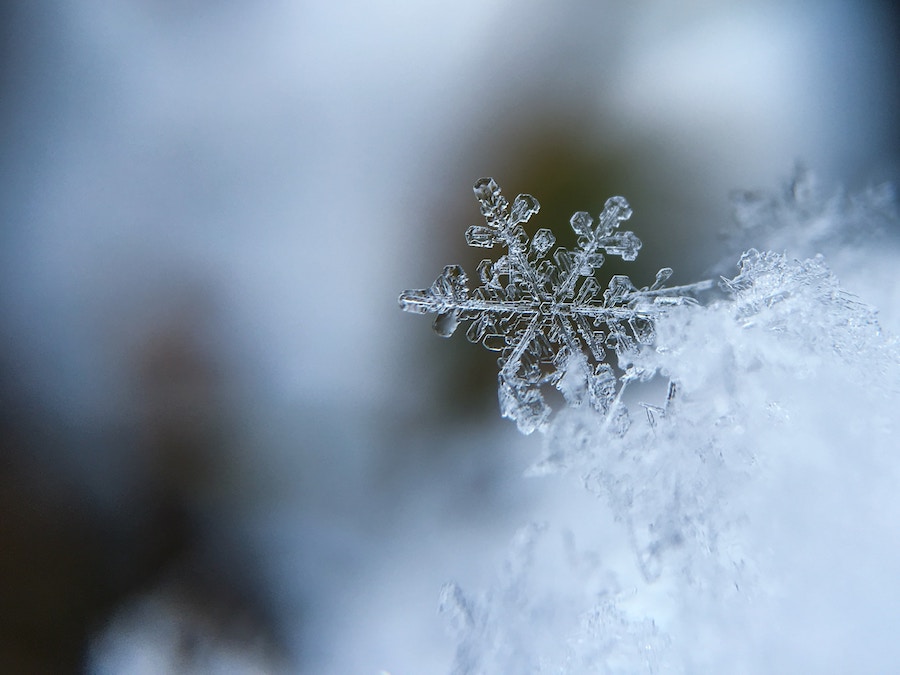
Snow fell here in the far north of Canada where I live, covering our streets in its white tenderness. In winter, we find ourselves in a time of keeping warm, in the space within, contained for love, peace and clarity. The sun is rebellious, especially in snow it always wins. And then it stretches along the frozen waves, clears the pools and we match its heat comes spring. Winter calls us to remember to tend to ourselves, from our inside of. Bared branches call us to absolute honesty, as nothing now may hide us from our eyes.
Snow White is a winter’s tale, and perhaps precisely for these wisdoms hidden in snow that this is its landscape. It’s a story of initiation, transformation, and ultimately a path towards a deeper caring. While in winter all seems harsh and empty outside, underneath life still thrives like our beating heart, and natural beauty is preparing to re-surface in few months time, like the scent of wild roses. As if on a white blank canvas, new stories will be written, and will, inevitably, begin.
For many people today, the tale of Snow White evokes images of dwarfs whistling in the mountains and of a yet-another princess dancing and singing, waiting for her prince to save her. But that’s not what this tale is about at all. To be honest, it wasn’t a favourite of mine as a child, and I actually found it very cruel and terrifying. My deeper interest towards it only sparked when I started diving into the lore and symbology of it; and the more I learned about it, and unveiled its many layers, the more I started to love it. That’s what happens in life: We can only love what we appreciate. Not love in a deep passionate way, but love in a way of appreciating something or someone for who they are, as they are, and seeing beauty in that.
In truth, no matter how much Disney may change Snow White and shape it into something childlike and naive, the original narrative is one of the darkest ones in fairytales. It’s a chilling tale that as most other tales wasn’t initially written for children, and many of its darker themes remind us of the lore and history of Sleeping Beauty. Snow White is a tale about murderous rivalry; envy, rage and the imprisonment of our minds; poisoned gifts and witchcraft; adolescent sexual ripening; and well, ritualistic cannibalism. And yet, somewhere in between all of that, Snow White holds deep spiritual wisdom and real beauty. Just like Sleeping Beauty, just like Cinderella, just like all of our other heroines and their voices.
Let’s begin.

Snow White by Trina Schart Hyman
Popularized by Brothers Grimm, Snow White was originally titled Snow Drop and was published in Kinder–und Hausmarchen in 1812. While the legend is that the brothers would roam the country from house to house and collect wisdoms from German peasants, what’s known is that they acquired most of their stories from their middle class circle of friends. These friends were retelling stories learned from their maids, servants, governesses, and many of them were not German.
Elements from the story can be traced back to the oldest fairytales, but the earliest known written version was published in Italy in 1634 by Giambattista Basile, called The Young Slave. This is then followed by a few more Italian versions, until we come across the Scottish version of the tale in which a queen has a magic mirror, and each day she looks at it asking, “Am I not the loveliest woman in the world?” And she is indeed, at least physically. Until the day when her daughter comes of age and surpasses her in beauty. Full of envy and rage, the queen falls ill and demands of the king the death of their daughter.
In the first published version by Brothers Grimm, the narrative of Snow White and her birth mother remained, which certainly makes the tale more chilling. Seven years later, Grimm republished the tale and introduced the evil step mother instead, replacing the birth mother. Whether mother or step mother, this queen remains one of the most vivid villains in fairytale history. Grimm also introduced dwarfs in the story since this was something common in German folk traditions.

Snow White by Trina Schart Hyman
As a winter’s tale, Snow White begins in the icy landscapes of a forest, where sitting by an open window with a wooden frame, a queen is sewing, while looking outside at the falling snow, longing for a child.
She pricks her finger.
Blood falls on the snow, and with newfound deep hope and belief, she whispers her true heart’s wish:
“Would I have a child, may it be with lips red as this blood, skin white as this snow, and hair black like the wood on the window frame.”
These three colours are significant as they represent the coming of age for Snow White and the entire narrative as well: red representing life, passion and sexual ripening; white representing innocence, purity and new birth; and black representing death, transformation and rebirth.
Three is also the number of manifestation: one makes a spark; two makes a connection and interchange; and three is what creates a circuit, which then ground the energy and makes it physical. Seven is another number often used in fairytales and spiritual initiations because it is highly spiritual and relates to higher power. In astrology, it also connects aspects with Saturn and Uranus, which is why we have the seven-year itch, and why significant cycles are in the frame of seven years.
Like many other tales, Snow White has spiritual meaning and it includes spiritual initiations. It’s an invitation towards a deepening. And if we move through the woods well, we’ll rejoice and dance around the fire after.
Initiation requires three phases: separation, challenge/descent, and returning. In our first invitation, we separate from something we felt comfortable – we are awakened to something beyond our known, and while disillusionment can be painful, it is merely a spiritual wisdom that is seeking to be born through us.

Snow White by Trina Schart Hyman
As the doorway opens here through the breakdown of a tower we had built, we may choose to enter now and find what’s true for us. It can be separating from a belief system, groups or friendship or relationship, and a path towards embracing our authenticity and what we really need. Not all will walk through that new door of self discovery, as it requires courage and resilience.
If we do walk through, we enter the deep forests – here begins the tall trees, the enchantments, the dragons, all of our shadows come to be faced by us. Here we deepen in self compassion and self acceptance.
And then love returns us to love. We see the light of fire outside of the woods, and we rejoice around it dancing. We’ve come back. We’ve returned to our true needs and our heart, to who we really are right now.
In this tale, falsehood needs to be burned to guard the sacred.
And then we rest,
we rest in the stillness of eternity; our silence anchors the worlds.
Of that returning to our heart, we may now guide the soul home through kindness, compassion and love without end.
When we lose ourselves, deep in the forest, we need to remember that the remedy is always tenderness. In the old days the “evil eye” was known as a condition that caused dryness, and we too dry up when faced with challenges. And then we harden up and armour up. Protection is of course needed and we must always protect our innocence and tenderness; these precious gifts are not meant to be shared with anyone who is not respectful, appreciative or trustworthy.

Snow White by Yvonne Gilbert
Yet we must also remember that we too need water. We need nourishing, nurturing, compassion, forgiveness and support, especially during our hard times, so that we stay soft-hearted and take one step, after another. Just like Snow White, along the way, things and people will come to remind us of our love and will care for us, support us and help us, but we must be open enough to recognize it and allow it. And at the same time, we will meet people whose hearts can’t meet us. Life offers all we can learn love from; and sometimes we learn what is by seeing what it isn’t.
For Snow White, this is an invitation to burn falsehood to guard the sacred – to mature into herself as a woman. She begins her path because she is forced to, but it is what frees her at the end. She is able to keep her heart because of it.
And then she rested. As the silence of winter, she anchored stillness within, she anchored the worlds and the soil underneath her.
With her love without end, snow melts and spring comes, she found her way home through the kindness and compassion which as if bless her with eternal life.
Despite the challenges she faced, hatred never was able to enter her kingdom within.
And water always flowed. It never froze, it never evaporated becoming a desert.
It kept flowing, and she kept staying tender, with soft hands and soft skin.

Snow White by Trina Schart Hyman
The evil queen too was faced with her own initiation. She was invited to walk into her inner wildlands after her reality collapsed seeing someone was more beautiful than her. She too was, well, disillusioned. But she never left the forest. It actually became deeper and darker for her, as jealousy and rage overtook her.
She came to a crossroad in her deep woods, and was faced with two choices. Grace, or not. She chose not. She reached her hands for something even darker – dark magic. She was seeking to harm intentionally; she was seeking to take something not hers. This only fractured her soul, and deepened her into more darkness of which she couldn’t climb up.
There is something absolutely chilling and horrific about what she does. She not only wants the girl killed, as if that’s not psychopathic enough, but she wants her heart in her hands, and she eats it. This is dark ritual. We see this in the older tales of Sleeping Beauty, such as Sun, Moon and Talia by Basile; where there too a queen wanted to eat and absorb as her own the purity and beauty of someone else.
It is the girl’s heart that makes her truly beautiful; and this is what the queen wants: to take Snow White’s beauty and youth as her own. But one’s true self can never hide, and when the soul is ugly it will eventually show no matter what “beauty” you fill yourself to.
The queen is imprisoned by her envy and inner ugliness. This is why she uses things like dark magic. The so-called “dark magician” is a weak one. If she honestly had real power, she wouldn’t need to take something not hers and use external means to get it. This only shows how weak she is. People with true power don’t need to do such things.
While the queen temporarily she becomes “beautiful and rich” again, with all other tricks she does in her kingdom, eventually it all always slips through her fingers like sand. We can’t keep something that isn’t ours and isn’t of resonance to who we truly are.
To forge and initiate a new path for ourselves needs to be an inner process: an inner alchemy process to bring forth the new energy. This is what Snow White does in the forest, and then in the crystal coffin before awakening.
However, when a person refuses to change internally, such as the queen seeking external means to get something that doesn’t belong to her, this is externalizing the alchemical process. This essentially weakens their own energy, and as such, the queen grows weaker and weaker, uglier and uglier.
Within the evil queen is emptiness. She tries to hide it through all external ways, but this only deepens her in more emptiness. Inside her she lives in worlds of fear, insecurity, rage, unrepairable loneliness and chronic dissatisfaction. Potions, lotions, poisons are the only tools she has for self-preservation.
Driving the evil actions of the queen, is perhaps also an even deeper fear: the fear of mortality. She wants her youth back, she wants to fool fate.
But this also makes me think of our current age. In today’s age, women are constantly pressured by unrealistic standards of beauty and eternal youth. Fillers, filters, how can anyone love themselves after unfiltered in the mirror?
I feel compassion for the stories we hold as humanity about the “aging woman” – who she who in our world is made to feel like external beauty is all there is. How many women today are made to feel like with aging comes being discarded. Aging is a privilege; it gifts us wisdom and confidence hard earned – it is something we need to celebrate and support in one another.
Yet natural beauty is rarely seen today. Perhaps we’ve even forgotten what a real face looks like – with pores, with wrinkles, with the wisdom of time touching our skin, saying “hey, you are alive, isn’t that a gift?”
In our modern world we are often made to be something we are not, to feel ashamed of our grey hairs as we age, of our changing bodies. We are conditioned to feel that once our 30s end, all ends and we should just go into be a recluse somewhere, or make out faces look like some filter that we don’t even recognize anymore when we look into our mirrors. We lose ourselves that way. We forget that it’s okay to have pores on our face, to have cellulite – it’s all natural.
What makes true beauty isn’t skin nor age – it is who we are as people, how we treat others, our values, our ability to love, our true inner essence and movement through life. And yet, here we are living in world where we are either young maidens or crones, and where sparkles and material surfaces are what are treasured.

Snow White by Jennie Harbour
The enchanted mirror serves not only as a story narrative, but it is a symbolic representation of the queen’s fears, insecurities, growing madness. Snow White too is a mirror. She is the reversed mirror of the queen. She reflects all she is not. Each day she becomes more loving, more kind, more generous of heart – and the queen becomes the opposite.
As pure and beautiful as Snow White is, she also reflects her ability to believe, to dream, to trust, and to hope with an open heart. And the queen remembers even more, of how much she’s lost within herself, or if how she failed to ever have it anyway, and this deeply pains her. And so, she wants to destroy it.
And this is the sad truth. There are people still in this world who are triggered by kindness, love and beauty. Instead of being inspired by it, they seek to destroy it.
The queen is a sad person. She lives in castle, with power and riches, and yet nothing satisfies her. In reality, all she has is a mirror in her hands, and even that becomes unfulfilling, because, of course, there’s emptiness inside of her, and we all know, nothing external can soothe our internal. It’s dangerous too, because we become more desperation seeking something else to fill us, and as a result, more vulnerable to false light. Devilish temptations promising us anything and everything.
It is so important to have something in our life that fulfills us, that makes us feel purposeful. It is so important to find our self-love and self-worth that are independent of the riches and crowns and Instagram filters. And we also need to have a northern star – something of higher value and love that will guide us in the times when we feel lost or tempted to fall into bad ways.
But was Snow White really naive to eat the apple even after all the other poisoned gifts?
Perhaps it wasn’t naivety. Perhaps just like any young girl, she longed for a mother’s love, a woman’s love. Perhaps she knew the hands who are giving her poison, but she still wanted to make her happy – for a chance that she may be held by her, no matter the reason, the way she once did, once upon a time, before all the internal fears and demons overtook her.
What the apple did, however, was freeze the girl in time, like a talisman, away from the evil sight of the queen, so that she can be at peace for awhile. It essentially protected her until she was in true loving arms.
The sleep is important in the tale, and in all tales, including Sleeping Beauty. This is not inaction – it is needed as we come into all parts of us that we thought we might have lost, and as we heal. Another aspect of the sleep state, or the isolation in a forest phase, often portrayed in fairytales is the need for solitude and self-knowledge before being able to sustain a true love relationship.
In many traditions, before the marriage, the groom and bride must be separated from one another for a few days. During this time, they each pray and meditate, and only after they’re centered in their selves, they are able to synchronize their energies and walk the path of love together, while supporting each other’s unique soul’s paths.
Love is not to be found, but to be felt in any circumstance.
In our tale, Snow White comes across the being of love as she nurtures and contributes to the wellbeing and happiness for the dwarfs; she is able to express her love with her caring for them and their home, and through that, she also comes into her own ability to love and to give unconditionally. Because love is not just something to feel, it is to give of ourselves and contribute to one another’s life.
Love has many different shapes and forms, and various speeds and movements; and when we have the hearts to see it, we will understand that we can experience love in many ways in our everyday life.

Snow White by Yvonne Gilbert
In many modern versions, particularly Disney retellings, Snow White wakes because of a kiss, but that’s not how the old tales were. In the Grimms’ version of the tale for example, the body of Snow White is placed into a crystal casket and given to be carried uphill to a prince passing by. However, one of his servants trips, the casket falls, and accidently the poisoned apple piece flies from her mouth.
The girl wakes and cries now knowing where she is, but the prince holds her hand and assures her,
“Dear Snow White, you are safe. You are with me.”
This is what the beautiful girl needs to awake, and to heal. Safety awakes us, love and caring heal.
In Polly Peterson’s poem “The Prince to Snow White” the prince responds to her upon her awakening when she questions whether he loves her only for her beauty,
“Did you think that I found you by chance, Maiden? Did you believe I was drawn to your crystal casket, like a hummingbird to its nectar, by the allure of ruby lips, the gaze of azure eyes? … You are beautiful, sublime, yet not so lovely as our daughter will be: your mother’s daughter’s child — her immortality.”
Here beautifully we see the power of acceptance, which is a power of love, for true love is acceptance. We see that physical beauty fades, but true love and inner beauty always shine. What makes us beautiful is our hearts. This love is what we’ll give to others forward; it’s our legacy. And despite the wrinkles and greys in our hair, beauty will still shine, for it is love, true love.
As for the prince, I too believe in love at first sight for I know it’s true: love is something felt deep within us and sometimes we just know. To see someone’s inner beauty is also, often, as if written on the gentleness of their face, the kindness of their movements. And we just know. The heart knows, always.
The world moves for love. It kneels before it in awe.
Then, now, always.

Illustration by Trina Schart Hyman
And so, it is. Warm blood against white snow. Life, and we, renew again. Spring always follows winter. The sun is rebellious, especially across the surfaces of ice. And we deepen into a drop containing all of our intimacies; water nourishes the soil of our soul, and we wake, anew, each time.
What Snow White knows is that our heart will lead us no matter the harshness of terrain. She knows that truth and love are eternal, immortal. She knows that we need grace, compassion and forgiveness. Again, and again, and again, and then all again thereafter.
What Snow White knows is that every day is a new opportunity to write our story on a blank canvas. She knows no one can take what’s truly ours. She knows true beauty comes from within.
And perhaps more than anything, Snow White knows that we need to honour our heart’s tears, as well as our deep longing for a world where we truly feel a belonging.

For more of my writings, browse through my Art of Love.
If you wish to support me and my work, you may do so by sharing it or donate here. For personal readings with me, you may visit my Offerings.
Your support means so much to me! Thank you wholeheartedly!