This essay is part of my book What She Knows – Volume II: Story Threads from Myth, Folklore, and Fairytales. To learn more about the book and order, please visit its official page here.
It was dark inside the wolf,
almost as dark as inside the human suit
… or what some may call, the tale of Little Red Riding Hood.
There are stories we enter, and those from which we return.
There are some stories which never remain on the surface – they ask of us something. Not only to listen, but to enter, to choose the paths, to follow them in places where the familiar begins to loosen, and where understanding is no longer immediate.
Some entering are not mere openings, they are thresholds that have already been quietly stepped into.
And from there, paths are no longer simple, no longer obvious. Encounters will now ask of us to choose – the path of needles or the path of pins.
Choices that seem small, are not. Moments where something is perhaps sensed, but not yet fully understood.
Into the forest the path isn’t always clear,
and not everything we meet is what it seems.
Little Red Riding Hood knows something about this.
She knows the path of pins and needles.
Little Red Riding Hood holds layers upon layers upon layers. The deeper we enter its wildlands the more reveals itself to us in wisdom. Long before it was retold by Charles Perrault, an oral folk tale, called The Grandmother’s Tale, was told in the French countryside.
Shaped and reshaped by the folk tradition in rural France, these are the roots of the girl who choose between the path of needles and the path of pins.

Illustration by Lisbeth Zwerger
The Grandmother’s Tale: The Path of Pins or Needles
There are many versions of it, as it was an oral tale, but in general the story goes like this:
A woman finished her baking, so she asked her daughter to take a fresh galette and a pot of cream to her grandmother who lived in a cottage deep into the forest. The girl set off, and on her way she met a bzou (a werewolf).
“Where are you going? What are you carrying?” asked the bzou.
“I’m going to my grandmother’s house to bring her some bread and cream,” said the girl.
“Which path will you take – the path of needles or the path of pins?
“I’ll take the path of needles,” said the girl.
“Very well then. I’ll take the path of pins, and we’ll see who gets to the house first.”
The girl set off, the bzou set off, and when he got there first, he ate the grandmother, put on her clothes and slipped into the bed in disguise.
When the girl arrived, the bzou told her to put the bread and cream in the pantry, come into bed with him,
“Take off your shoes, my dear girl. Good, now, take off your coat, and dress, and shirt, and come into bed to cuddle up together and be warm.”
As the girl did as told, and came closer to the bed, she suddenly recognized that this was the bzou, and so she used her wits and said, “I’ll come into bed, but I must go outside for a while, dear grandmother.”
“Okay, my child,” said the bzou, “but hurry and come back. And because I am worried about you, I’ll tie a little woolen thread to your ankle, so that you don’t get lost in the darkness, or even worse, get eaten by the bad wolves outside.”


Illustration by Lisbeth Zwerger
When the girl went outside, she immediate cut the thread with the scissors in her pocket, and tied it to a plum tree.
When the bzou called for the girl, she didn’t answer, so he ran outside to chase her. Hearing him behind her, the girl ran to the river bank that her grandmother had once told her about; and there were the wise women laundresses.
To help her cross, they spread a white cloth sheet over the water, holding it tightly by its ends, and the girl used it as a bridge to escape.
When the bzou came, he asked for the same to be done, but when he was half way across, the women dropped the cloth, he fell into the waters and drowned.
Numerous variants of The Grandmother’s Tale were collected by French folklorists in the 19th and 20th centuries in the Loire basin, the Nivernais, the Forez, the Velay, the northern Alps, and the Italian Tyrol. Italo Calvino published a version from Abruzzo in his collection Italian Folktales (1956), and called it The False Grandmother. In his story a hungry ogress takes the place of the wolf – but in other respects, the story is quite similar to the French folktale. Then of course there is Charles Perrault’s tale Little Red Riding Hood (1697) where we see the introduction of the red hood; and in the Brother’s Grimm tale, we also see the hunter who helps the girl escape the wolf.

Illustration by Daniel Egnéus
The Path of Needles or the Path of Pins
In many ways, spinning and weaving also represented the life of wise women, intuitives, healers and herbalists that lived into the forests, or in some privacy away from the “mainstream”, because they carried the wisdoms of the lineage and the mysteries of life.
So in the tale, this is what the grandmother symbolized as well – and the girl initiates herself through the wisdom being handed to her.
Spinning and sewing were also big parts of women’s lives and labour, and these were often done in communities, in spinning rooms or tents, and around the evening fires. The women would gather together and tell many tales to each other, while also relieving their own worries and share in their emotions, which also created a space of women belonging.
In the folklore, traditions, and rituals of rural women in remote areas of France, many girls from the villages were sent off to spend a winter with local seamstresses during puberty – this passage of time marked a girl’s change from child to young woman.
This almost apprenticeship had less to do with learning to “work”, to sew and use needles, and was mainly about learning to refine yourself, polish yourself, learn patience and devotion, and learn to dress up and self-adorn. The seamstresses would often say of their apprentices as, “They have been here this winter gathering pins.”
Along with their winter time with the seamstresses, the girls would also enter a consecrated ceremony to Saint Catherine to signify their arrival at maidenhood (la vie de jeune fille).
La vie de jeune fille was essentially their permission to go dancing and have sweethearts, of which the pin was a symbol. It was by offering the girls dozens of pins that boys formerly paid court to girls; it was by throwing pins into fountains that girls assured themselves a sweetheart.
While pins marked the path of maidenhood, younger girls and beginning to learn about womanhood, needles implied sexual maturity.
The eye of the needle, in the folklore of seamstresses, symbolized the male penetration into the woman and the creation of pleasure or something “new” woven. In some parts of Europe, courtesans once wore needles on their sleeves.
But this eye of needle is so much more than that: as sexual energy for women is essentially our creation energy, we continuously create and weave something new, whether it is meals, books, poetry, music, gardening – we make love continuously. This is the magic woven – out of love and intention, something new is born always.

Illustration by Daniel Egnéus
When the girl in our tale chooses the path of needles, in a way, she is hurrying up too fast to grow up. As such, this tale served as caution to exercise discernment when choosing a man, and tame their temptations – because some wolves walk out of the forests to disguise themselves as charming men.
The wolf is that within us which holds our appetites – foods and sweet, sexual desires, tempted by dangers when we ignore our intuition and good reason. The key is self-knowledge, awareness and discipline. Some lands we should not enter before their right time, or if we do, we must be prepared to seek the help and support of the wise ones.
The wolf is also that within us which serves as the catalyst for change, our maturity and spiritual transformation. He is that which is when innocence first meets danger – and he is that which sharpens our own instincts and senses.
Our sexual energy as women is very powerful, and each time we share ourselves with a man we absorb his energy into ours. This affects us. This is why it is important to be mindful of whom you chose. Choosing our right partner is one of the most important decisions we’ll make in life, so discernment and wisdom are needed.
From a historical perspective this tale is quite important also. Charles Perrault retold his own unique version of the tale, and this is how the voices of the grandmothers reached the courts of kings and aristocratic readers.
The king’s court was famed for its wealth, its intrigues, and its sexual excesses, particularly as practiced at the king’s sumptuous playground of Versailles. At the same time, virginity in young brides was absolutely insisted upon, because marriage was a business arrangement contracted between two families, and a girl’s market value decreased sharply if her virginity was compromised.
Perrault’s story addressed the subject of seduction and rape. What “rape” was defined as during those times was any instance in which a man would take a woman without the consent of her father, regardless of whether or not she wanted it. So, if a woman was in love with a man and wanted to marry him, but her father didn’t agree, that’d be rape. If she didn’t want to, yet her father agreed to the arrangement, any sexual intercourse no matter how brutal, forced or unwanted, would not be rape.
This is because during that time in France, fathers had basically ownership over their daughters, and the absolute legal to right to determine whom their daughters would marry. Any man who seduced or married a young woman without her father’s consent was guilty of rape, regardless of the woman’s wishes.
To avoid this occurrence, daughters were often kept locked in convents until they married in order to avoid romances and elopements. Perrault’s own wife had been raised in a convent, emerging shortly before their marriage, and Perrault had only seen her once before the actual wedding.

Illustration by Gina Litherland
What was happening during that time simultaneously, was that women in Paris were beginning to speak their voice and truth and rebel against these mistreatments. They wanted to have sexual freedom and romantic freedom to be with whom they chose, and marry whom they wanted. These rebellious voices were often supported by the women who hosted the French salons.
The salons were basically private clubs where women of status would mix with men, as they all gathered to exchange intellectual ideas, and many famous women authors were part of those salons also. It is in the French salons where fairytales were born, as these were tales initially written for adults to raise awareness on various social and political issues. A quiet revolution was forming, though women still had to be careful for not all men in these salon had their best interests for change.
Perrault himself was a frequent visitor to the salons, and as an intellectual, he often championed modern culture, which was generally more favorable to women. Having said that, he still had to keep his heroines bien faites and gentilles, i.e. good girls not rocking the boat too much, because of his royal court audience.
At its heart, and spoken in subtle ways, Perrault’s tale was intended as warning to the French salon women also – cautioning them not to mix nor trust too much the men they meet there; he warned the women that they may get involved with some men who may destroy their reputation and end up imprisoned, banished, prosecuted or even killed.
Perrault’s wolf was perceived as the charmer of the Parisian high class society, the seducer of young beautiful educated women, and a threat to the family patrimony. He is the wolf who is the “unsuitable suitor”, charming his way into the best beds in town, deflowering women, and robbing them of their virginal values.
Perrault began writing fairytales at the age of 67, when he decided to be fully dedicated to his children and their care. Inspired by them, he wrote beautiful tales, and at each tale’s end he’d include a moral, like a personal message to all children.
In Perrault’s words, his tale was to gently caution his darling girls against being too trusting with men, as “the seemingly tamed wolves were often the most dangerous ones.”
His message was to caution all children and youth against older men being predatory and to be watchful when they walk the streets of Paris. He warned of the wolves walking out of the forests and being disguised as charming Parisian men who take advantage of young girls and women.
What this tale reminds us of is knowing our values as women, to know our worth. It reminds us to beware of the charming suitors who show up with all fancy words and promises and sparkling chalices on our porches and front doors, because for all we know, it could be dark inside the human suit.
There is nothing romantic about having a relationship with a Bluebeard. And Joe Goldberg from Netflix’ You isn’t the kind of man you want to be loved by neither, despite his charm and perhaps some physical appeal. There’s nothing romantic about narcissists, psychopaths, obsession, manipulation, abuse, and being in a toxic relationship or marriage.
The line between pleasure and pain is thin indeed, sometimes very seductive, and danger will always have its certain appeal; but we must also remember our instincts, never ignore our gut feelings, trust our intuition, and when something is off, we must put on our own animal body, get out, and seek help and support.
Women who’ve walked these paths know.
Little Red Riding Hood knows the path of both pins and needles, and what happens deep into the woods. But she also knows how to outwit the wolves, and how to depend on the wiser women for support and help.
And every time we tell her story, we are reclaiming and honouring the spirits of all who faced wolves in their lives and were able to outwit them – wolves not only of those walking externally, but those who walk our own inner wildlands also.
This essay is part of my book What She Knows – Volume II: Story Threads from Myth, Folklore, and Fairytales. To learn more about the book and order, please visit its official page here.

For more of my writings, browse through my Art of Love.
If you wish to support me and my work, you may do so by sharing it or donate here. For personal readings with me, you may visit my Offerings.
Your support means so much to me! Thank you wholeheartedly!
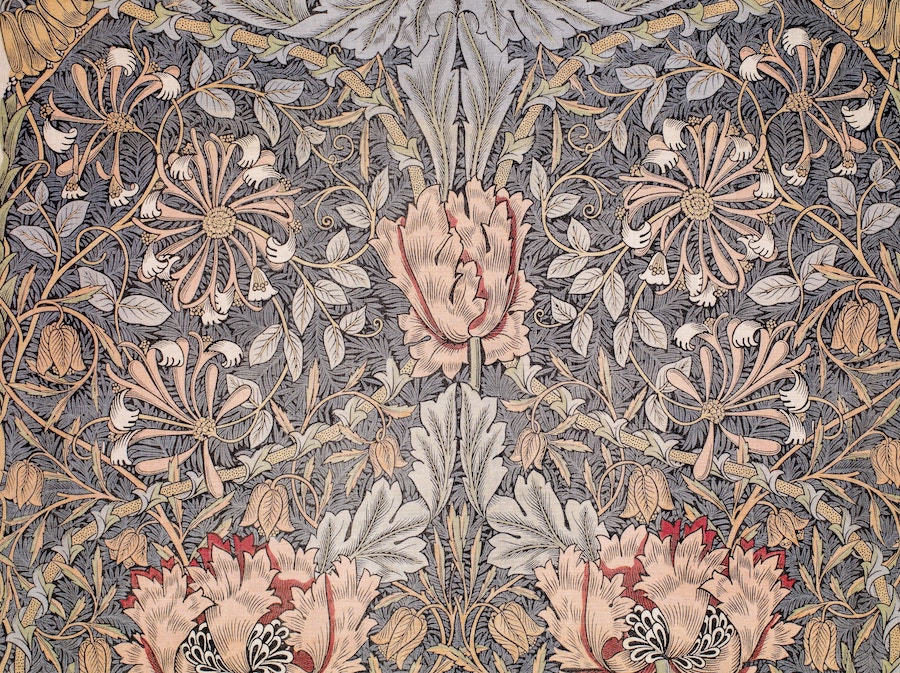
Cover art: Birmingham Museums Trust. Source: Unsplash.