This essay is part of my book What She Knows – Volume I: Story Threads from Myth, Folklore, and Fairytales. To learn more about the book and order, please visit its official page here.
Once when I was a little girl, we were renovating the flooring in our house and I gathered the leftover parquet pieces; I glued them together, so that I’d make furniture for my dollhouse. My dollhouse was an empty cupboard near my bed. Limits make you creative, clever and skillful; they expand your imagination to go beyond what you have in front of you – this is how we enter the worlds of the possible. I even cut smaller pieces and painted them with handwritten words – so now my dolls had bottles of milk, fresh fruit and flower vases.
And then there were the dresses …
Together with my mom, we’d take little pieces from old clothing and fabrics, run a single thread and make new dresses for my dolls. Stories and feelings sewn in, woven in. Dresses made not only of textiles, but of stars, dreams, moons, and seas, sewn together by loving hands.

Helen Stratton
Imagine:
Floral curtains from old rooms, faithful lace from attic’s chest, vintage tablecloths, a threadbare silk dress, velvet pillow covers, painted cotton balls and beads from bracelets, all looking to be experienced as a new adventure with a new story to tell; old loves with shapes renewed breathe life again, as secret threads make them into doll dresses and bedsheets.
Secret threads run by our desires, by the very things that are special only to us as the souls of our hands shape them. The secret threads know nothing is forgotten, nothing is unfound. And eventually it will touch us.
You may have noticed that the dress you really love, or the book you really love, are all bound together by secret threads. The books of all these tales I tell you are old books sitting on my shelf – their pages bound by threads, holding stories within stories within stories. Just like life itself.
To other people, it might be nonsensical why you might love that dress or that book, and yet not love another. It’s a secret perhaps only our heart knows; a mystical calling of love that feels like the breeze on our skin and shifts our eyes towards the unknown horizon.
And then there we are… not really knowing why we love something or how we even came this far, but it just makes sense one day. We now see what the threads were making.
It’s these secret threads that pull us forward in life, usually in the form of desires, as we go deeper into the unknown not knowing why. It’s the little things that we are attracted to, drawn to, like our interests or hobbies
and all the times when our eyes shift towards the distance as if we are looking for something, waiting for something, watching for something, listening for something.
What are we seeking?
We’ve never had it. All those things that deeply possessed our soul along the way were perhaps just only the hints of it; glimpses of almost but not yet, promises never quite fulfilled, echoes that faded away yet still linger catching our ears in the wind-blown leaves. What are these things? These desires that pull us even when it doesn’t make any sense, even when it is all dark around us and we are still choosing to walk barefoot.
It’s the secret threads connecting.
Until one day we find ourselves before the landscape, which embodies everything that we have been looking for our entire life. And the echo that called us for so long now swells into the sound itself.
And we know.
Here is the one I was made for.
Threads of Life
In myth and magic, the threads referred to the various ways in which the threads of fate lead us towards various destinations and to one another, so that we fulfill our destiny and soul’s purpose. There is abundance of tales and lore across various cultures connecting spinning and weaving to the divine and to the threads of fate, such as in Sleeping Beauty where the young princess meets her fate by the spinning wheel, while the prince is then led to her by the strings of his heart calling him into the forest.
There is also the famous concept of The Web of Wyrd, which reminds us that it is our own actions every day that weave the yarn for the day after; a web marrying fate with destiny. Wyrd is not just referring to our individual life paths but to the universe itself; a vast spider’s web where everything is interconnected, multifaceted and all future possibilities are available to us, as we weave our cloths of life.

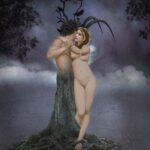
Art by Arthur Rackham
“Suddenly the branches twined around her and turned into two arms.”
In ancient Greek religion and mythology, we also have the Moirai, which are the three Fates; they were the incarnations of destiny ensuring that every being, mortal and divine, would live out their destiny by the laws of the universe. For mortals, this destiny spanned their entire lives, and was represented as a thread spun from a spindle. And in East Asian beliefs originating from Chinese mythology, there is also the Red Thread of Fate, also known as the Red Thread of Marriage, stating that an invisible red cord connects the fingers of those true lovers destined to meet in their divine timing. No matter how tangled the cord would be, it could never be broken and the universal forces will align to make sure that the meeting happens.
Threads and spinning are very often used in lore, tales and storytelling. The verb to spin actually first meant the act of making, and then evolved to mean telling a tale. We weave fates as we weave stories.
In tales, the heroines often spin cobwebs, straws into gold and knitting nettles into clothes to survive. Scheherazade keeps spinning and spinning, incorporating new fragments and characters into her unbreakable narrative thread, so that the king doesn’t kill her. In Rumpelstiltskin, the miller’s daughter spins straws into gold with the help of an elf but then has to repay him with her firstborn and in The Wild Swan the heroine gathers nettles at night to knit shirts for her brothers in order to break the spell and save them.
The magic of every spinner is that they form out of formlessness; incredible shapes come of threads, or words, that contain a world.
From fishing nets to nightgowns, continuity out of fragments, narratives and meanings out of seemingly scattered incidents align to make something beyond our expectations; because each storyteller is also a spinner or weaver and the story is the thread that flows through our lives to connect us to one another and to the purpose and meaning that appear on our paths.
And yet these threads are often not only invisible but they are also silent. We see the symbolism of this in The Wild Swan, where the girl must knit the shirts for her brothers without speaking a word; the nettles bruise and hurt her hands but she continues without giving up. And so, we all spin and spin, weave and weave, one thread into another, and the secrets of them are known only to us.
The sudden appearance of the patterns of the world in the stories we read bring us a sense of connection and unity. In some stories we see ourselves and they engage our inner worlds in a deep way that awaken within us our own wisdom, nurture our own inner flames, and allow us an opportunity for a deepening.
And we also see how we are all connected to one another; woven into the universal pattern as if we are the stories ourselves, telling and being told. The stories embody who we are, what we desire, what we fear and where we came from long ago.
And yet sometimes perhaps what we want are the openings … the immortality of the unfinished, the yet to come, the waiting for our desires, the uncut threads, the incomplete, the open doors in the forest and the open seas.
What if we actually liked for the brothers to be swans and the nettles to be not yet woven into shirts; what if the quest was greater than the holy grail?
The quest is the holy grail, or so I’m told, though when I really want something and work hard for it without seeing much result, the last thing I’d be interested in are some idealistic statements.
But I also know how it feels to see the open sea, how in love I am with it and how fulfilled, and how it is really the mysterious love elixir, never-ending and ever desiring. Perhaps this is the best part about desire – it is always ahead of us.
Art Making
Art making, like life making, is a magical yet challenging process. It requires vision and skill, but its most important ingredient is often times faith. Faith in the project. Faith in ourselves. And the courage and perseverance to keep on working through the bad days as well as the good days. In many ways, it becomes an art of fear, an art of doubt, an art of uncertainty. In every step of the process something will be put to the test. Fears and doubts may arise when we look back and when we look forward, when we face the tyranny of the before and after, when we have a moment of a disaster fantasy, and when vision races ahead of execution.
In his book “Art and Fear” author David Bayles shares a story: There was a young student who once began piano lessons with a Master. After a few months practice, he felt frustrated and asked his Master, “I can hear the music so much better in my head than what I can play with my fingers.” To which the Master replied, “What makes you think that ever changes?”
As Bayles writes, vision is always ahead of execution, and it should be. Desire is also always ahead of us, and it should be. Uncertainty, doubt, knowledge and vision are all inevitabilities of life – because life, like art, is a making.
No matter how many concrete roads we build, the paths of life are never straight nor direct; they are full of twists and turns yet somehow, mysteriously, they always align in their own timing. As much as we want to control things and know things, we can’t; we were never meant to know it all, and in our unknowingness is where we touch the miracles. When we stop doing the work, we begin the work; when we stop knowing, we begin to know.
There will always be a moment when we lose our way; when we feel our way has gotten away from us. Things begin to look flat, confusing, uninspired and we lose vision. All our choices have begun to look misdirected and wrong, and we can’t see our path forward; we are lost in the wilderness. But that’s part of life, part of art. Perhaps it is precisely in these moments when we let go, freed from expectations, that things align and we remember ourselves. When we feel lost, we need to have confidence that we are not lost but rather we are at the point of new discovery.
When I was writing my poetry books, often times I felt lost, uncertain or just in some perpetual state of daydreaming i.e. floating. It was perhaps surrender. Now looking back, I see all those secret threads that are known only to me; why a poem was the way it was, who it was written for even before I knew it, how much hard work and brave heart the book creation process was, how I felt during each moment and what each word really means to me, how I have these two books in my hands and yet there were many moments when I felt the pages would collapse as I held their stories, and how some of my most favourite lines came in last minute, as if by magic or a sea breeze, in the middle of the night, and had I published even a few days earlier I would have missed them. Divine timing indeed.
We never fully know what will emerge and where it will lead us, no matter how much we plan it. We go through life and somehow learn trust and the not knowing. We let go and surrender, accepting all the in-betweens. Our unconscious will delicately guide us in certain directions and though we haven’t installed the sun yet – we just follow it blindfolded, and always, always in some mysterious way, for some mysterious reason, threads begin to form patterns, rivers plaid when moss is cold, and suddenly all begins to take substance, coming into its being.
And then we have a book, or a wedding dress, bound by a single secret thread;
and what emerges is a love story, a hope story, and a story of trust.
For more of my writings, browse through my Art of Love.
If you wish to support me and my work, you may do so by sharing it or donate here. For personal readings with me, you may visit my Offerings.
Your support means so much to me! Thank you wholeheartedly!
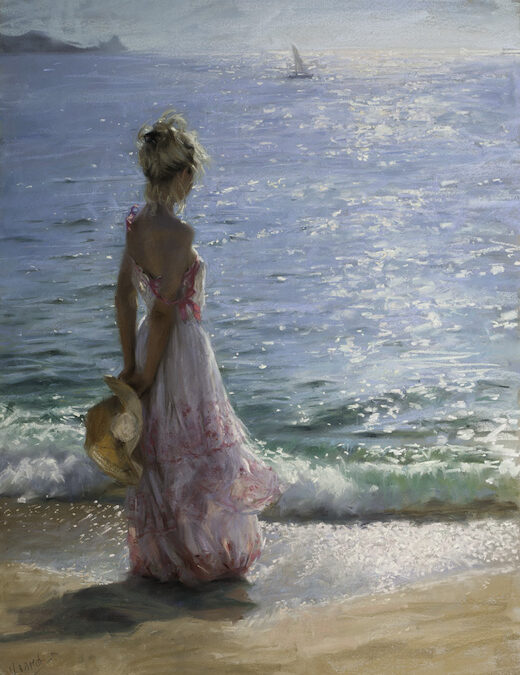
Cover art by Vicente Romero Redondo, 2009, via Wikimedia Commons. The artist’s official website is at vicenteromeroredondo.com